

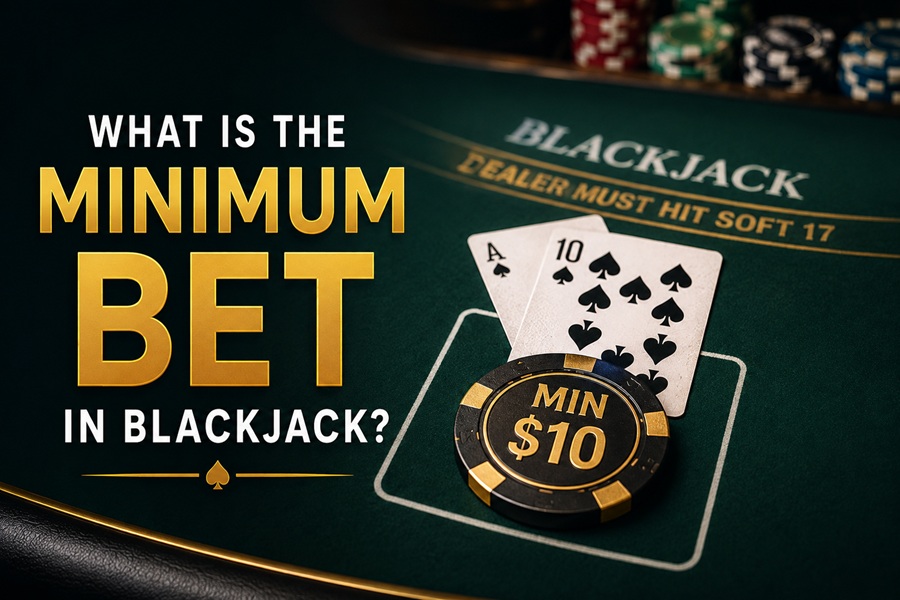
The minimum bet in blackjack is the smallest amount you can wager per hand to be dealt in. In most brick-and-mortar casinos it runs from $5 to $25, with $10 and $15 being the most common. Low-limit and online tables can start as low as $1, while high-limit tables begin at $100 or more. The exact minimum depends on the casino, the location, the time of day, and the table rules, and it is always posted on a sign at the table.
Before you sit down at a blackjack table, one number decides whether you belong there: the minimum bet. It sets the price of every hand and, more than any strategy tip, it determines how long your money lasts. This guide explains what the minimum really is, the ranges you will actually see, the factors that move it, and the hidden costs most beginners miss.
What does the minimum bet in blackjack mean?
The table minimum is the least you can wager on the main betting spot to join a hand. If a sign says “$15 minimum,” you must put out at least $15 before the cards are dealt. Bet less and the dealer will ask you to add to it or step away.
The minimum is always displayed, usually on a small placard on the felt near the discard tray, or on the screen in online and live-dealer games. It is one of the first things a smart player checks, because it decides how many real decisions your bankroll can survive.
One important point: the table minimum tells you the price of one starting bet, not the true cost of a round. Splits, doubles, and side bets can multiply that number fast. More on that below.
What is the typical minimum bet in blackjack?
There is no single answer, because it swings with the venue and conditions. Here is a realistic map of what you will find.
| Setting | Typical minimum | Typical maximum |
|---|---|---|
| Online blackjack | $1 or less | $500 to a few thousand |
| Low-limit live tables | $5 to $10 | $500 |
| Standard live tables | $10 to $25 | $1,000 |
| Las Vegas Strip (off-peak) | $15 to $25 | $500 to $1,000 |
| High-limit rooms | $100 and up | $10,000 or more |
A few patterns hold across almost every casino:
- Online tables offer the lowest minimums by far, sometimes just cents on certain sites.
- On a busy casino floor, $10 and $15 tables are the sweet spot most players look for.
- High-limit tables start high and pay out big, but the swings match.
What factors change the minimum bet?
The same casino can show wildly different minimums from one table to the next, or from one hour to the next. These are the levers.
- Location. Betting culture varies by region. Prime Strip real estate tends to carry higher minimums than a locals casino or a regional property.
- Time of day and week. Minimums rise when demand rises. A table that is $15 on a weekday morning may jump to $25 or more on a busy weekend night.
- Player demand. When seats are scarce and players are willing to bet big, casinos raise minimums to make each seat more profitable.
- Table rules and payout. This is the big one. Lower-minimum tables often pay 6:5 on a blackjack, while better tables pay 3:2. A cheap seat can quietly cost you more through a worse payout.
- Game type. Single-deck and double-deck games usually carry higher minimums than six-deck shoe games.
How do the minimum and maximum bets relate?
The minimum never travels alone. Every table also has a maximum, the most you can wager on a single hand, and the two are linked.
A common rule of thumb is that the maximum is roughly 50 to 100 times the minimum. So a $10 table often maxes out around $500 to $1,000, and a $100 high-limit table can allow $10,000 or more.
Why cap the top at all? Partly to limit the casino’s exposure, and partly to defeat aggressive doubling systems. A player using a strategy that doubles the bet after every loss would eventually need an enormous wager to recover, and the table maximum makes that impossible. The limits box you into a range on purpose.
Why does the minimum bet matter for your bankroll?
Because the minimum, not your total cash, decides how many hands you get to play. Pick a table that is too rich for your roll and your money vanishes in minutes.
A widely used guideline is to bring at least 50 to 100 minimum bets for a comfortable session. On a $10 table that means roughly $500 to $1,000 to ride out normal swings.
Here is the nuance that catches people out. Blackjack is not one bet per hand. When you split or double, your money on a single round can jump to two, three, or four times the minimum. Picture a $25 table with $300 in front of you. That looks like twelve bets. But split once, double once, and lose a couple of normal hands, and you can be down well over a hundred dollars in minutes with nothing unusual happening. The minimum did not change the rules. It changed the size of every swing.
The takeaway: choose a minimum where a single bet feels routine, not stressful, and leave room for the doubles and splits that good strategy demands.
Is the minimum bet different online versus in a casino?
Yes, significantly.
- Online minimums are far lower. Digital tables have no floor space to fill, so they profit from volume. Many start at $1, and some go lower.
- Live and land-based minimums are higher. A physical seat has real overhead, so casinos price it accordingly, especially during peak hours.
- Live-dealer online games sit in between. They stream a real dealer and often carry minimums closer to a physical table than to an RNG game.
If you are learning or on a tight budget, online low-limit tables let you play many more hands for the same money. If you want the atmosphere of a real table, expect to pay more per hand.
Watch the payout, not just the minimum
One last piece of advice that separates informed players from the rest. A low minimum is not automatically a good deal.
The single most important number after the minimum is the blackjack payout. A 3:2 game pays $15 on a $10 blackjack. A 6:5 game pays only $12 on that same hand. Over a session, that difference quietly drains your bankroll far faster than a slightly higher minimum would.
So the smart order of checks is: find a minimum that fits your roll, then confirm the table pays 3:2 and avoid 6:5 whenever you can. A $15 table paying 3:2 beats a $10 table paying 6:5 for almost everyone.
Frequently asked questions
What is the lowest minimum bet in blackjack?
Online, it can be $1 or even a few cents. In a physical casino, the lowest you will usually find is $5, often only during quiet hours.
Why do blackjack minimums change during the day?
Casinos raise minimums when demand is high, such as evenings, weekends, and events, and lower them during slow periods to fill seats.
Does the minimum bet include splits and doubles?
No. The minimum is your starting bet only. Splitting or doubling adds another bet of equal size, so a single round can cost two to four times the minimum.
What is the maximum bet compared to the minimum?
It is usually 50 to 100 times the minimum. A $10 table often allows up to $500 or $1,000, and high-limit tables go much higher.
How much money should I bring for a blackjack table?
A common guideline is 50 to 100 minimum bets, so around $500 to $1,000 for a $10 table, to survive normal swings and play a full session.
Is a cheaper table always better?
Not necessarily. A low minimum paired with a 6:5 payout can cost you more than a slightly higher minimum that pays 3:2. Always check the payout rule too.