

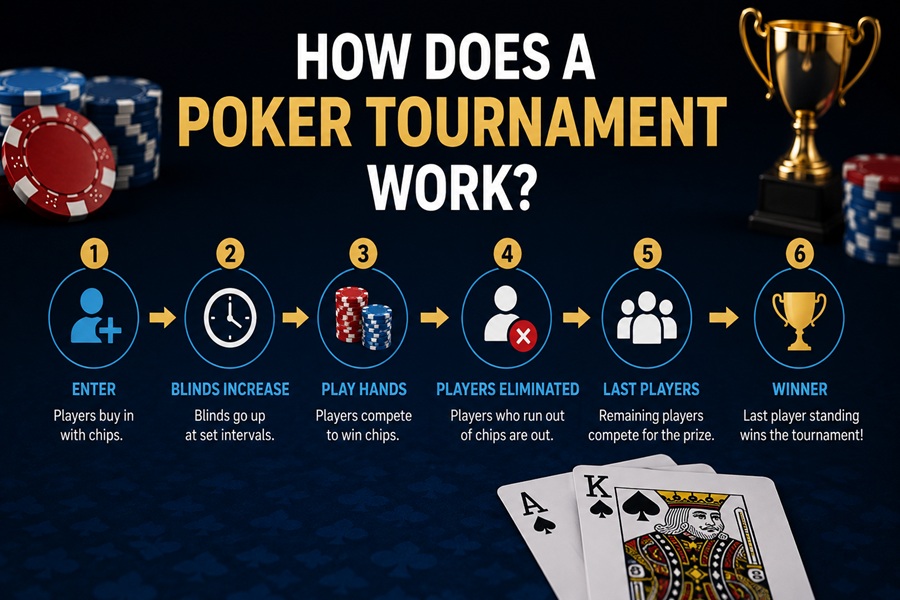
In a poker tournament, every player pays the same buy-in and receives the same starting stack of chips that have no cash value. Blinds rise at set time intervals, forcing action and eliminating players who run out of chips. The tournament ends when one player holds all the chips. The prize pool, built from the buy-ins, is paid to the top finishers, usually the top 10 to 20 percent, with the biggest share going to the winner.
A poker tournament is a different beast from a casual cash game. Everyone starts equal, the clock is always ticking, and the pressure builds until one person has it all. This guide walks you through a tournament exactly as it unfolds, from the moment you pay in to the moment someone stacks the last chip, then covers the formats and payouts along the way.
Tournaments involve real money buy-ins. Play within your means, treat the buy-in as entertainment, and if gambling stops feeling like a choice, free confidential help is available in the US at 1-800-GAMBLER.
What happens when you enter a poker tournament?
It starts with the buy-in, a single fixed entry fee that is the same for every player. That is the most you can lose in a standard freezeout, which is one of the appeals: your risk is capped at the door.
Your buy-in usually splits into two parts:
- The prize pool contribution. The bulk of your money, pooled with everyone else’s to form the payouts.
- The entry fee, or rake. A smaller cut the operator keeps to run the event.
In exchange, you receive your starting stack of chips. Here is the crucial part: those chips have no cash value. You cannot trade them back for money. They are simply tools to survive and accumulate. This is what keeps tournaments fair, since a richer player cannot reach into a wallet and buy a bigger stack mid-hand. Everyone begins with exactly the same ammunition.
Why do the blinds keep going up?
This is the single feature that defines tournament play. In a cash game, the blinds stay fixed. In a tournament, they climb.
Blinds are forced bets posted before the cards are dealt. The small blind and the big blind, usually double the small, rotate around the table so everyone pays their share. They exist to guarantee there is always something to fight for.
In a tournament, the blinds increase at set intervals called levels. A level might last from a few minutes to a couple of hours depending on the format. As the levels climb, antes often join in, another small forced bet, sometimes posted as a single big-blind ante that covers the whole table.
The effect is relentless pressure. Your stack is best measured in big blinds, not chips. You might start 100 or more big blinds deep, with room to play carefully. As the blinds rise, that same stack shrinks in relative terms, and folding your way to a prize becomes impossible. Sooner or later, you have to make a move.
What are the stages of a poker tournament?
A tournament is a journey through distinct phases, each demanding a different approach.
| Phase | Typical stack depth | What it feels like |
|---|---|---|
| Early | Deep, often 100 big blinds or more | Room to play carefully and see flops |
| Middle | Compressing toward 30 to 40 big blinds | Antes bite, opening ranges tighten |
| Bubble | Short and tense | One spot from the money, everyone plays scared |
| In the money | Varies | You have secured a payout, now climb |
| Final table | Often short | Every elimination is a pay jump |
| Heads-up | Two players | One-on-one for the title |
A few of these deserve a closer look.
- The bubble is the moment just before payouts begin. If the top 100 get paid, the player who busts in 101st is the “bubble boy,” walking away with nothing while everyone left cashes. Play tightens dramatically here.
- In the money, or ITM, means you have outlasted enough players to guarantee a prize. From here, survival still matters, but now every place you climb is worth more.
- The final table is the last remaining table, where the largest prizes live and each knockout bumps everyone up the ladder.
How do poker tournament payouts work?
The prize pool is built entirely from the buy-ins, or from a guaranteed amount the operator promises. Once late registration closes and all entries are in, the full prize pool and payout structure are locked and announced.
Two principles govern the money:
- Only a slice of the field gets paid. Typically the top 10 to 20 percent finish in the money. Everyone else leaves empty-handed.
- The structure is steeply top-heavy. The winner takes the largest share by far. In big-field events, the top three finishers can capture 40 percent or more of the entire pool, while the minimum cash is often only around one and a half to two times the buy-in.
This is why a tournament can turn a small buy-in into a life-changing score. The trade-off is that most entrants win nothing, and the swings are far bigger than in cash games.
What is ICM, and why does it matter near the money?
Here is a concept many guides gloss over, but it explains a lot of tournament strategy.
Because tournament chips are not worth a fixed cash amount, the real money value of your stack is not simply proportional to your chip count. The Independent Chip Model, or ICM, is the math that estimates the actual dollar value of your stack based on the payouts still available.
The practical effect shows up near pay jumps, like the bubble and the final table. When busting out costs you a guaranteed pay rise, risking your chips becomes more expensive in real terms than the raw chip count suggests. That is why good players tighten up in those spots and lean on push-or-fold decisions. Understanding ICM is what separates casual entrants from serious tournament players.
What are the different types of poker tournaments?
Not all tournaments run the same way. Here are the formats you will meet.
| Type | How it works |
|---|---|
| Freezeout | One buy-in, no second chances. Bust and you are out |
| Re-entry or rebuy | You can buy back in during the registration window |
| Turbo and hyper-turbo | Short, fast blind levels and higher variance |
| Deep stack | Large starting stacks and slower blinds, more skill |
| Sit and go (SNG) | Starts as soon as the table or field fills, no set time |
| Multi-table (MTT) | The standard large-field format across many tables |
| Satellite | The prize is a seat or ticket into a bigger event, not cash |
| Bounty and knockout (KO) | Part of the prize is a reward for eliminating each player |
| Progressive knockout (PKO) | Bounties grow as you collect knockouts |
| Mystery bounty | Knockouts pay a random, sometimes huge, hidden reward |
| Freeroll | No buy-in, real prizes |
One rule of thumb from experienced players: the deeper the starting stack and the slower the blinds, the more skill decides the outcome. Very shallow, fast structures are affectionately nicknamed “luck-fests,” because there is little room to maneuver before you are forced all in.
How is an online tournament different from a live one?
The core rules are identical. The experience is not.
- Speed. Online tables deal far more hands per hour than live ones, and you can play several tables at once.
- Access and stakes. Online events run around the clock with buy-ins starting at well under a dollar. Major live events often require travel and much larger buy-ins.
- Reads. Live poker adds physical tells and table atmosphere that online play cannot replicate.
- Satellites. Both offer satellites, letting you win a seat into a flagship event for a fraction of its buy-in, often by climbing a series of cheaper qualifiers.
Frequently asked questions
How long does a poker tournament last?
Anywhere from under an hour for a turbo sit and go to several days for a major multi-day event. Length depends on the starting stacks, blind speed, and field size.
How many players get paid in a poker tournament?
Usually the top 10 to 20 percent of the field, with payouts rising steeply toward the top finishers.
Can you lose more than the buy-in?
In a freezeout, no. The buy-in is your maximum loss. In re-entry or rebuy events, you can spend more by entering again during the registration window.
What does “in the money” mean?
It means you have outlasted enough players to guarantee a cash prize, having survived past the bubble.
Why do tournament chips have no cash value?
They are only a scorekeeping tool for the event, which keeps every player on equal footing. Your winnings come from the prize pool, not from cashing in chips.
What is the difference between a tournament and a cash game?
In a cash game, chips equal real money and blinds stay fixed, so you can leave anytime. In a tournament, you pay a set buy-in, blinds rise, and you play until eliminated or victorious.