
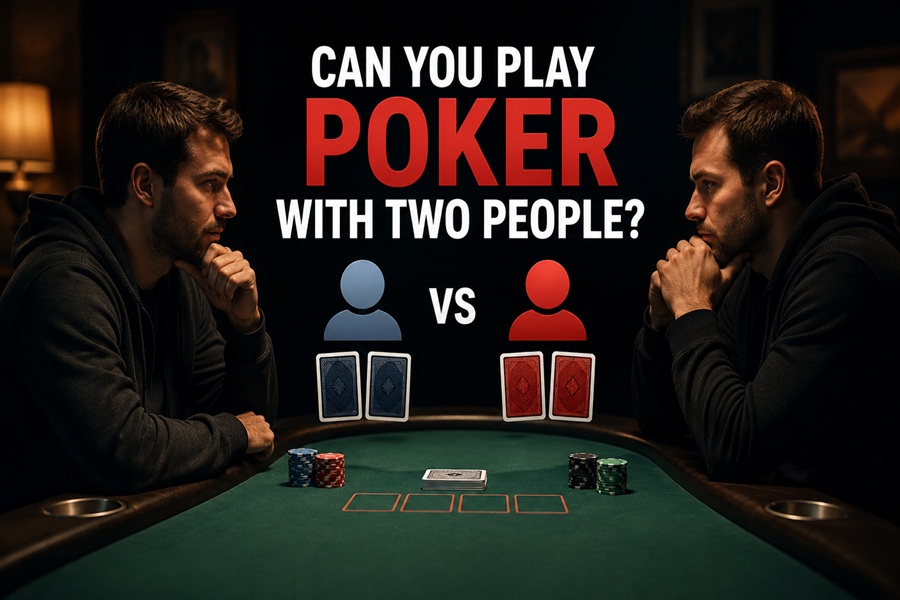
Quick answer: Yes, you can absolutely play poker with two people. It is called heads-up poker, and it uses the same hand rankings and betting rules as any other game. The one thing that changes is the blinds. With only two players, the dealer posts the small blind and acts first before the flop, while the other player posts the big blind and acts first after the flop. Master that single rule and you can play a full game one-on-one.
Maybe you are stuck at a home game with only one friend, or you are down to the last two players in a tournament, or you just want to sharpen your game one-on-one. Whatever the reason, poker with two people is not only possible, it is one of the most skill-testing ways to play. This guide covers the one rule that trips everyone up, how to set up a two-player game, and how your strategy has to change.
Can you really play poker with just two players?
Yes. Two players is the minimum for a real game of poker, and it has its own name: heads-up poker. You will also hear it called one-on-one or head-to-head.
It shows up in three common situations:
- The end of a tournament, when the field narrows to the final two players competing for the title.
- Dedicated heads-up games, both cash tables and small tournaments built for two.
- Home games, when only two people are around and you still want to play.
Everything you already know still applies. The deal, the betting rounds, the showdown, and the hand rankings are all identical. Only the blind and button setup is special.
How do the blinds work in two-player poker?
This is the whole trick, so read it twice. In heads-up poker, the blind roles are the reverse of what beginners expect.
- The player on the dealer button posts the small blind.
- The other player posts the big blind.
That is the opposite instinct from a full table, where the button sits apart from the blinds. With two players, the dealer and the small blind are the same person.
Here is who does what, round by round.
| Situation | Dealer / button (small blind) | Other player (big blind) |
|---|---|---|
| The deal | Receives the second card | Receives the first card |
| Before the flop | Acts first | Acts last, has the option to raise |
| After the flop, turn, river | Acts last | Acts first |
Two clean rules to memorize:
- The dealer acts first before the flop.
- The dealer acts last after the flop.
If you can remember that the button always acts last once the community cards are out, the whole thing clicks into place.
Why is the reversed blind rule so confusing?
Because it looks like an exception, but it is not. It is the same underlying rule every poker game follows.
In any game, the button must act last after the flop. At a full table that means the small blind acts first post-flop. With only two players, the button is the small blind, so the same rule forces the dealer to act first before the flop and last afterward. Nothing is broken. The principle is just applied to two seats instead of nine.
Experienced dealers and coaches will tell you this is the most common rules mistake at the table. When a home game or pub tournament reaches the final two, players constantly reverse the blinds or the action order without realizing it. If you get the blinds right and remember the button acts last post-flop, you are already ahead of most casual players.
How do you set up a poker game for two people?
Setting up a heads-up game at home takes about a minute. Here is the practical routine.
- Decide the game. Texas Hold’em is the most popular for two, but Omaha, five-card draw, and most variants work fine heads-up.
- Pick who deals first. The fair way is for each player to draw a card from the deck. High card deals the first hand.
- Post the blinds. The dealer puts out the small blind, the opponent puts out the big blind. Agree on the amounts in advance, or play for fun with no money at all.
- Deal correctly. The first card goes to the big blind, the second to the dealer. The dealer never deals to themselves first.
- Play the hand. Follow the action order above through each betting round to showdown.
- Move the button every hand. Swap the button after each hand so the blinds alternate. If the same person stayed on the button, they would pay the small blind forever, which is unfair.
A common home-game touch: keep one deck in play and have the second deck shuffled beside whoever deals next, so there is no downtime between hands.
How does strategy change when playing heads-up?
A lot. Two-player poker rewards a completely different mindset than a full table, and clinging to full-ring habits will get you run over.
- Hand values transform. Any two cards have potential heads-up. A small pair becomes strong, and even ace-high often wins at showdown. Waiting for premium hands like aces or kings just bleeds blinds.
- Aggression rules. Because you are in a blind every single hand, passivity is punished. Skilled heads-up players raise a very high share of buttons, often well over half, to keep constant pressure on.
- Defend widely. When you are in the big blind, folding too often lets your opponent steal relentlessly. You must fight back with a wide range.
- Position is king. The button gives you last action after the flop, which is a huge edge. You play more aggressively with it and more cautiously without it.
- Shallow stacks mean push or fold. As stacks get short, especially late in a tournament, decisions often collapse into moving all in or folding before the flop.
The math itself does not change, and in one way it gets simpler: there are never multi-way pots, so calculating your odds against a single opponent is more straightforward.
Where can you play poker with two people?
You have plenty of options, whether or not you have a second person handy.
- At home, with a single deck, some chips, and one friend.
- In heads-up cash games and sit and gos at live cardrooms and on online poker sites.
- At the business end of any tournament, where the last two players always finish heads-up.
- Against the software, since many online poker apps let you practice heads-up formats, and some offer solo play against the house in regulated markets.
Because heads-up games often use lower blinds and give you constant action, they are also a great way to practice. You make far more decisions per hour than at a full table, so your learning speeds up.
Frequently asked questions
What is two-player poker called?
Heads-up poker, also known as one-on-one or head-to-head. It is the minimum format for a real poker game.
Who is the small blind in heads-up poker?
The dealer. In two-player poker, the player on the button posts the small blind, and the other player posts the big blind.
Who acts first in heads-up poker?
The dealer acts first before the flop. After the flop, the big blind acts first and the dealer acts last on every remaining street.
Who gets dealt the first card heads-up?
The big blind receives the first card, and the dealer takes the second. The dealer never deals to themselves first.
Can you play Texas Hold’em with only two players?
Yes. Texas Hold’em heads-up is the most popular two-player format, and Omaha, five-card draw, and other variants all work one-on-one too.
Is heads-up poker harder than a full table?
It is more demanding in some ways, since you play every hand, act under constant pressure, and cannot fold and wait. But it is also a fast, pure test of skill that improves your whole game.