

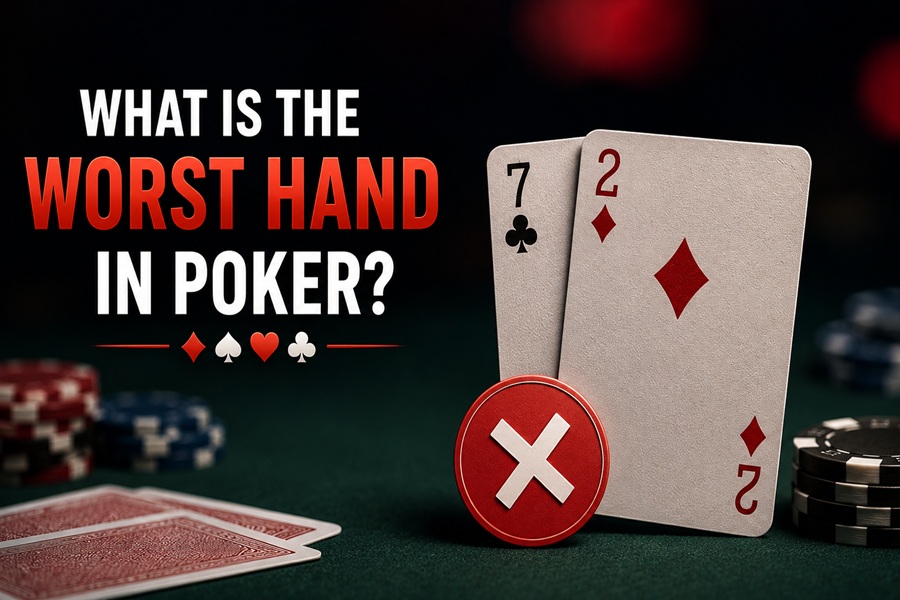
Quick answer: The worst hand in poker usually means one of two things. As a starting hand in Texas Hold’em, the worst is 7-2 offsuit, because it makes almost no strong straights, flushes, or pairs. As a finished hand at showdown, the worst is a plain high card, and the lowest possible one is seven-five-four-three-two with no straight or flush. Both answers are correct. They just answer different questions.
Ask a table full of poker players “what is the worst hand?” and you will get an instant answer: seven-deuce. But dig a little and you will find the question is trickier than it looks. “Worst” can mean the trashiest cards you are dealt, or the weakest hand you can end up with. This guide settles both, adds the technical footnote most people miss, and throws in the poker history that breaks the rule.
What does “worst hand in poker” actually mean?
The phrase has two everyday meanings, and mixing them up is why people argue about it.
- The worst starting hand. The two hole cards you least want to be dealt before the flop. This is a question of potential.
- The worst made hand. The weakest five-card hand you can show down at the end. This is a question of ranking.
Both are valid. Below, we answer each one clearly, then cover the edge cases and the exceptions.
What is the worst starting hand in poker?
The answer nearly every player agrees on is 7-2 offsuit, often written 72o.
It earns the title because it fails in every way a starting hand can fail at once:
- The cards are low. A seven and a two make weak pairs that stronger pairs easily beat.
- They are disconnected. The two ranks sit five apart, so they cannot combine into a straight. You will never flop a straight with them.
- They are offsuit. Different suits means no flush draw. Even the suited version makes only a weak seven-high flush that better flushes routinely beat.
Put simply, the cards work in isolation, not together. Almost every other trash hand keeps one saving grace. Six-five suited can flop a straight or flush draw. Ace-deuce can pair a strong ace. Seven-deuce offsuit has almost none of those escape routes, which is what pins it at the bottom.
Why is 7-2 offsuit so weak? Look at the equity
The clearest proof is equity, which is your share of the pot if a hand runs to showdown.
- Against pocket aces, 7-2 offsuit holds only about 12.4 percent equity, meaning aces win roughly 87 percent of the time.
- Against a strong suited hand like ace-king suited, it sits around 30 percent.
- The only hands it beats by equity are a tiny handful like 2-3 and 2-4 offsuit, which almost nobody plays anyway.
Here is how a few notorious weak hands compare against pocket aces, the best starting hand.
| Starting hand | Equity vs pocket aces | Why it struggles |
|---|---|---|
| 7-2 offsuit | About 12% | Low, disconnected, no flush |
| 8-3 offsuit | Low teens | Same problems, slightly higher cards |
| 7-3 offsuit | Low teens | Weak, wide gap, offsuit |
| 8-2 offsuit | Low teens | Poor connectivity and rank |
There is also a subtle point about real games. A hand’s raw equity is not the same as how much of that equity you actually keep. Because 7-2 offsuit lacks draws, it converts a smaller share of its theoretical equity into won pots, especially when out of position. That is why it plays even worse in practice than the numbers alone suggest.
Is 3-2 offsuit ever called the worst hand?
Yes, and this is the technical footnote worth knowing.
If you rank all 169 starting-hand types strictly by raw win rate against a single random hand, 3-2 offsuit actually finishes last, with 7-2 offsuit just above it. So by that narrow measure, 3-2 offsuit is the mathematical bottom.
So why does everyone still say seven-deuce? Because playability matters more than a coin-flip win rate. Against the stronger hands opponents actually raise with, 7-2 offsuit is the least useful holding to have. It has the worst combination of low win rate and no way to improve. That is why it is the practical worst, even when 3-2 offsuit edges it out on paper.
The clean way to hold both truths: 3-2 offsuit has the lowest raw win rate, and 7-2 offsuit is the least playable. Most players mean the second one.
What are the other worst starting hands?
Seven-deuce gets the headlines, but it has plenty of company at the bottom of the muck. These hands share the same flaws: low ranks, wide gaps, and offsuit cards.
- 8-3 offsuit
- 7-3 offsuit
- 8-2 offsuit
- 9-2 offsuit
- 6-2 offsuit
- 2-8, 3-8, and similar low, disconnected combinations
The common thread is poor connectivity, weak high cards, and no suited flush potential. When these hands do connect with the board, they tend to make second-best hands, the kind that quietly cost you chips against a better kicker.
What is the worst possible made hand at showdown?
Now the other meaning. If the question is about the weakest finished hand, the answer is a high card, the lowest category in the poker hand rankings.
The single worst high-card hand you can hold is seven-five-four-three-two, all different suits, with no straight and no flush. It cannot beat a pair, and among high-card hands it is the lowest of all. If two players both miss completely, this is the hand that loses.
So the two answers finally line up:
- Worst starting hand: 7-2 offsuit.
- Worst made hand: a bare high card, at its lowest seven-five-four-three-two.
Does the worst hand change in other poker games?
It does, and this is a fun twist most guides skip.
In lowball games, the goal flips: the lowest hand wins. So the hands you hate in regular poker become the hands you want.
- In deuce-to-seven lowball, the very best hand is seven-five-four-three-two, the exact hand that is the worst in standard high poker.
- In Razz, cards like a deuce and a seven that spell doom in Hold’em can be part of a strong low.
So “worst” is not absolute. It depends on the game you are playing and which direction you are chasing.
Has anyone ever won big with a terrible hand?
Yes, and it is one of poker’s favorite stories.
A legendary player won back-to-back major championships holding ten-two offsuit in the final hand both times, turning a weak, disconnected holding into a full house on each occasion. Because of that feat, ten-deuce is nicknamed after him to this day.
The lesson is not that ten-two is secretly good. It is not. The story survives precisely because winning with such a poor hand is so unlikely. It is the exception that proves the rule.
One more piece of trivia people confuse with “worst”: the so-called Dead Man’s Hand, a pair of aces and eights, tied to a famous shooting in the Old West. It is two pair, a perfectly playable hand. It is famous for history, not for being bad.
Frequently asked questions
What is the single worst hand in poker?
As a starting hand, 7-2 offsuit. As a finished hand, a high card, with seven-five-four-three-two being the lowest possible.
Is 7-2 offsuit really unplayable?
In almost every situation, yes, fold it. The rare exceptions are pure bluff spots with position against a weak opponent, and even those are advanced and situational.
Why do players say seven-deuce and not three-deuce?
Because seven-deuce is the least playable hand against real opponents, even though three-deuce has the lowest raw win rate against a random hand. Playability wins the argument.
What is the worst hand you can make at the river?
A high card with no pair, straight, or flush. The lowest of those is seven-five-four-three-two, unsuited.
Can the worst hand ever win?
Only through a bluff or a lucky board. As shown by the famous ten-deuce story, weak hands win occasionally, but relying on that loses money over time.
Does the worst hand change between games?
Yes. In lowball variants like deuce-to-seven and Razz, low cards are the goal, so the worst high-poker hands become strong low hands.