

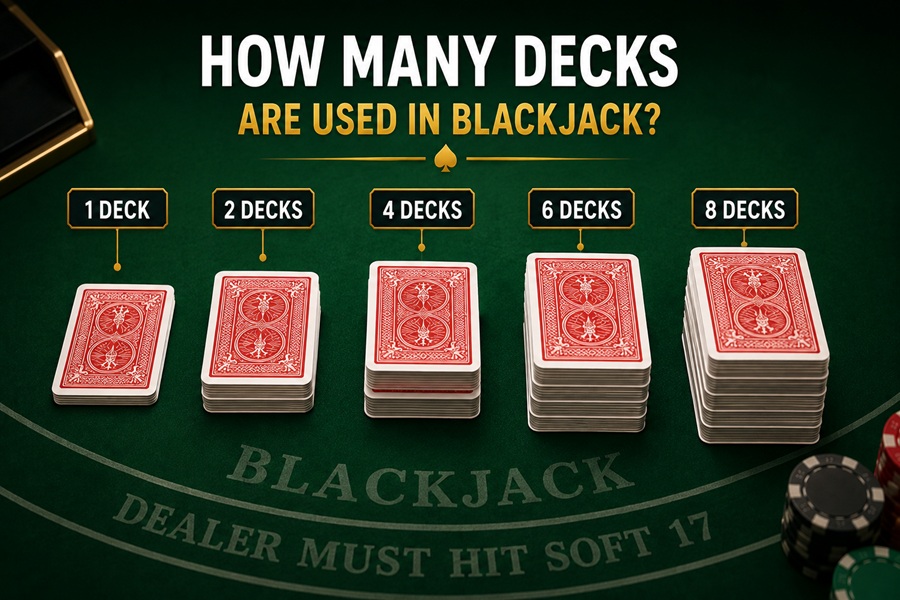
Blackjack uses anywhere from one to eight standard 52-card decks. The common setups are single deck (52 cards), double deck (104), four deck (208), six deck (312), and eight deck (416). Six-deck and eight-deck shoes are the most common on modern casino floors. Fewer decks give the player slightly better odds and a lower house edge, which is exactly why casinos favor multi-deck games and shoes.
Walk a casino floor and you will see tables labeled single deck, double deck, and six deck, all playing the same game with different odds. The number of decks is a small detail with a real effect on your chances. This guide lays out every setup, shows how deck count changes the math, and reveals the bigger factor that matters even more than the decks.
How many decks does blackjack use?
The range is one to eight decks. Beyond a single deck, casinos use only even numbers, so the standard options are one, two, four, six, and eight.
Each deck is a standard 52-card pack, so the card counts are easy to work out.
| Setup | Decks | Total cards | How it is dealt |
|---|---|---|---|
| Single deck | 1 | 52 | Usually hand-dealt (a “pitch” game) |
| Double deck | 2 | 104 | Often hand-dealt |
| Four deck | 4 | 208 | From a shoe |
| Six deck | 6 | 312 | From a shoe |
| Eight deck | 8 | 416 | From a shoe |
In multi-deck games, the cards are loaded into a device called a shoe, and the dealer draws them one at a time. Single-deck and double-deck games are often dealt by hand.
There is no hard maximum in theory, but casinos stop at eight because more decks add little and slow the game.
Which deck setup is most common in casinos?
Six deck and eight deck. These shoe games dominate modern floors, especially in busy destinations like Las Vegas and Atlantic City.
- Six-deck shoes are the everyday standard at most casinos.
- Eight-deck shoes are common too, particularly in high-volume rooms.
- Double-deck and four-deck games still exist but are less common.
- Single-deck games have become rare, and many major casinos have quietly removed them.
The reason for this shift is not a mystery. Multi-deck games favor the house a little more and make skilled play harder, which suits the casino.
How does the number of decks affect the odds?
Fewer decks are better for the player. It is a straightforward matter of probability.
With fewer cards in play, favorable cards like aces and tens stay more concentrated, which nudges several things in your favor:
- Natural blackjacks are slightly more likely. The chance of being dealt a natural is about 4.83 percent in a single-deck game versus about 4.75 percent in an eight-deck game.
- The house edge is lower. Playing perfect basic strategy, a single-deck game can drop the edge to roughly 0.15 percent, while an eight-deck game sits closer to 0.5 percent or more.
- Doubles and splits gain value. Removing a card changes the remaining deck more sharply with fewer decks, which slightly boosts these plays.
Here is the comparison at a glance, assuming the same rules across the board.
| Decks | Approx. house edge with basic strategy | Card counting difficulty |
|---|---|---|
| Single deck | Around 0.15% to 0.40% | Easiest |
| Double deck | Slightly higher | Manageable |
| Six deck | Around 0.4% to 0.6% | Hard |
| Eight deck | Around 0.5% and up | Hardest |
The total swing from one deck to eight is only about half a percent under identical rules. That sounds tiny, but over hundreds of hands it adds up.
Why do casinos use more decks?
Two reasons, and they work together.
- A higher house edge. More decks dilute the concentration of good cards, which quietly tilts the math further toward the house.
- Harder card counting. Counting works by tracking the ratio of high to low cards left in the deck. With six or eight decks in a shoe, a single card barely moves the count, so a counter needs advanced systems, true-count conversion, and deep discipline to gain an edge. Multi-deck games are not rigged. They simply make skilled advantage play much tougher.
That combination is why the single-deck game, once the standard, gave way to shoes as players mastered counting.
Does the deck count matter more than anything else?
No, and this is the point most guides bury. The number of decks matters, but the table rules and payout matter more.
The trap to avoid is a low-deck game with bad rules. A single-deck table that pays 6:5 on a blackjack is worse for you than a six-deck table that pays 3:2. The 6:5 payout quietly costs you far more than the deck count ever saves.
So judge a table by its whole rule set, not just the deck count. The rules that move the edge most include:
- The payout. Always favor 3:2 over 6:5. This is the biggest single factor.
- Dealer action on soft 17. A dealer who stands on soft 17 is better for you than one who hits it.
- Doubling and splitting rules. Double after split, re-splitting, and doubling on any two cards all help the player.
- Surrender. The option to surrender a bad hand lowers the edge.
A single-deck game is only a genuine advantage when it also pays 3:2 and carries fair rules. Otherwise, a well-ruled six-deck game wins.
Are online blackjack decks different?
Yes, and it depends on the format.
- RNG online blackjack uses a virtual deck that is effectively shuffled every hand. Because the count resets constantly, card counting is impossible, and the deck behaves like an infinite shoe.
- Live-dealer online blackjack streams a real dealer using physical decks, typically six or eight, just like a land-based casino.
There is a related device to watch for on physical floors too. Some tables use a continuous shuffling machine, which reshuffles after every round. It keeps the game fast and, like an RNG game, defeats counting entirely because the deck never depletes.
Which blackjack deck game should you play?
It comes down to your goals, and the payout check comes first.
- Want the lowest edge and plan to play skillfully? Seek a single-deck or double-deck game, but only if it pays 3:2. Expect stricter rules and higher minimums.
- Want availability, lower minimums, and a relaxed pace? A six-deck or eight-deck 3:2 game is perfectly fine with basic strategy.
- Whatever you choose, avoid 6:5. No deck count makes up for that payout.
The smart order of checks is: confirm the payout is 3:2, then look at the soft-17 and doubling rules, and only then consider the deck count. Get the first two right and the deck count is a small bonus on top.
Frequently asked questions about blackjack decks
How many decks are used in blackjack?
Between one and eight standard 52-card decks. Six-deck and eight-deck shoe games are the most common in casinos today.
Is single-deck blackjack better than multi-deck?
By odds alone, yes, since fewer decks lower the house edge. But only if it pays 3:2. A single-deck 6:5 game is worse than a six-deck 3:2 game.
Why do casinos use six or eight decks?
More decks raise the house edge slightly and make card counting much harder, both of which benefit the casino.
How much does deck count change the house edge?
Under the same rules, the difference from one deck to eight is roughly half a percent, with single deck being the most player-friendly.
How many cards are in a six-deck shoe?
312 cards, since each standard deck has 52. An eight-deck shoe holds 416.
Does online blackjack use real decks?
RNG online games use a virtual deck reshuffled every hand, so counting is impossible. Live-dealer online games use six or eight physical decks like a real casino.