

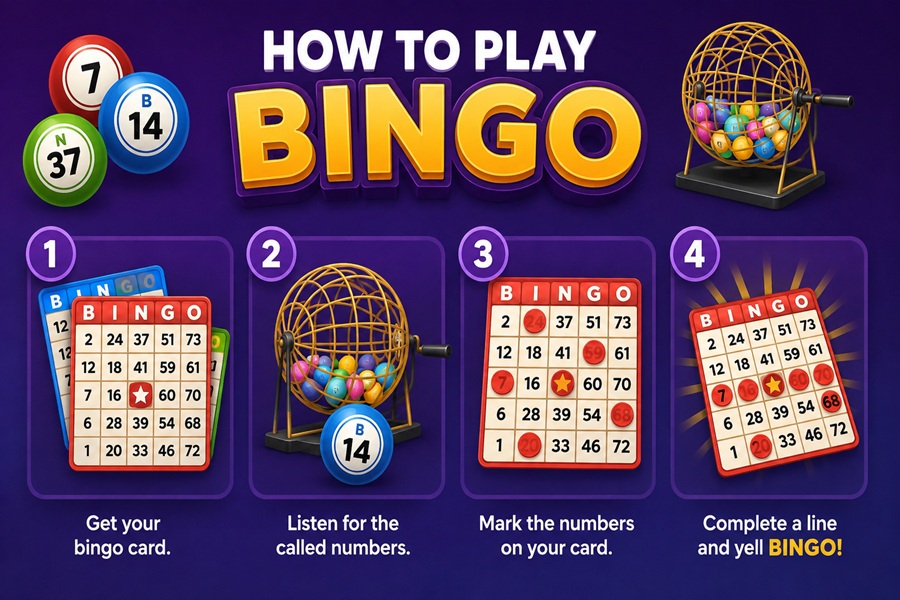
Quick answer: To play bingo, you buy one or more cards printed with random numbers. A caller announces numbers one at a time. You mark (or “daub”) any number that appears on your card. The first player to cover a required pattern, such as a line or the full card, calls out “Bingo!” and wins after their card is checked. That is the whole game in three moves: listen, mark, call.
Bingo looks simple from the outside, and it is. But the first time you sit down with a card, the speed and the lingo can feel like a foreign language. This walkthrough takes you from “I have never held a dauber” to “I know exactly when to shout.”
You will learn the core rules, how a card is built, the difference between the two main versions, the winning patterns, and the slang you will hear in the room. No prior experience needed.
What is bingo, really?
Bingo is a game of chance built on matching. Numbers are drawn at random. You check each drawn number against the grid on your card. When your marked numbers form the pattern the game is looking for, you win.
That is the part people forget: bingo is almost entirely luck. Your card is random. The draws are random. No skill decides which numbers come out. The only thing you control is paying attention so you do not miss a number or a valid win.
The game has three moving parts:
- The caller. A person (in a hall) or a random number generator (online) that draws and announces numbers.
- The card. A grid of random numbers unique to you.
- The pattern. The shape you need to complete to win, announced before the game starts.
How do you actually play a round, step by step?
Here is a single round from start to finish.
- Buy your cards. You can play one card or several at once. More cards means more chances, but also more to watch each time a number is called.
- Check the winning pattern. The host announces what you need. It might be one line, four corners, a shape, or the whole card. Know this before the first number drops.
- Get your marker ready. In a hall you use a dauber (an ink stamp). At home you might use chips, tokens, or a pen. Online, you tap or the app auto-marks.
- Listen and mark. The caller reads out a number. If it is on your card, mark it. Keep up, because callers move fast.
- Watch your progress. Track how close you are. When you need only one more number, you are “one to go.”
- Call it. The moment your card completes the pattern, shout “Bingo!” loudly and clearly. Say it before the next number is called.
- Get verified. A floor attendant or the system checks your card. A valid card wins the prize. A false call means the game continues.
If two players complete the pattern on the same number, the prize is usually split.
What does a bingo card look like?
A card is a grid of numbers. The layout depends on which version you play. Here is the anatomy of the most common one, the 75-ball card used across North America.
- It is a 5 by 5 grid, so 25 squares total.
- The letters B, I, N, G, O sit across the top, one per column.
- Each column pulls from its own number range.
- The center square is a free space. It counts as already marked.
Each letter locks to a range of numbers:
| Column | Number range |
|---|---|
| B | 1 to 15 |
| I | 16 to 30 |
| N | 31 to 45 (center is free) |
| G | 46 to 60 |
| O | 61 to 75 |
So when the caller says “B-7,” you only need to scan your B column. That letter tag is there to speed up your search.
What is the difference between 75-ball and 90-ball bingo?
These are the two versions you will meet most. They feel like different games once you play both.
| Feature | 75-ball bingo | 90-ball bingo |
|---|---|---|
| Popular in | United States and Canada | United Kingdom, Europe, Australia |
| Card shape | 5 by 5 grid, 24 numbers plus a free center | 3 rows by 9 columns, 15 numbers per ticket |
| Number range | 1 to 75 | 1 to 90 |
| How you win | Complete an announced pattern | One line, two lines, then full house |
| Free space | Yes, the center | No |
| Feel | Fast, visual, pattern-driven | Longer, three chances to win, social |
A few extra notes that most beginners miss:
- In 90-ball, players usually buy a strip of six tickets. Across those six tickets, every number from 1 to 90 appears once. So you are always marking something.
- 80-ball bingo exists too. It uses a 4 by 4 grid and was built for online play. It sits between the other two in speed.
- Speed bingo (often 30-ball) uses a tiny grid and ends in a flash. It is the quickest format going.
What are the winning patterns in bingo?
In 90-ball, the pattern order is fixed: one line, then two lines, then a full house (all 15 numbers). Three prizes, one game.
In 75-ball, the pattern is announced at the start and there are hundreds of them. Common ones include:
- Single line. Any horizontal, vertical, or diagonal row. The fastest win.
- Four corners. Only the four corner squares. Often a quick warm-up game.
- Postage stamp. A 2 by 2 block in a corner.
- Letters and shapes. T, L, X, diamond, cross, arrow, and picture frame, among others.
- Coverall, also called blackout. Every number on the card. The hardest pattern, and usually the biggest prize.
Because 75-ball uses shapes, US halls love themed and seasonal cards. Some rooms run more than 300 recognized patterns across the year.
What bingo words do I need to know?
Bingo has its own dialect. Here is a starter glossary so nothing throws you.
| Term | What it means |
|---|---|
| Dauber (dabber) | The ink marker used to daub numbers |
| Daub | To mark a called number on your card |
| Caller | The person or system announcing numbers |
| Free space | The pre-marked center square in 75-ball |
| Coverall / Blackout | Filling the entire card |
| Full house | Covering all numbers on a 90-ball ticket |
| One to go (1TG) | You need one number to win |
| False call | Shouting bingo without a valid card |
| Wild number | A called number that lets you mark all numbers ending in the same digit |
| Strip | A set of six 90-ball tickets bought together |
In some UK rooms you will also hear traditional call nicknames, like “two little ducks” for 22 or “legs eleven” for 11. They are for fun and are fading, but they still pop up.
How can beginners improve their chances?
Bingo is luck, so no trick guarantees a win. But a few habits genuinely help.
- Play more cards, within reason. More cards means more chances. Only take as many as you can comfortably track. A missed daub is a missed win.
- Arrive and settle early. Sort your cards, dauber, and space before the pace picks up.
- Pick quieter sessions. Fewer players means fewer cards in play and better odds per card. A midweek afternoon beats a packed weekend night.
- Keep your cards tidy. Line them up so you can scan all of them the instant a number is called.
- Stay calm on close calls. When you are one to go, do not freeze. Have your dauber ready.
Here is a nuance most guides skip. Some experienced players cite two old ideas about number spread:
- Granville’s approach suggests choosing cards with a balanced mix of high and low, odd and even numbers, and varied final digits.
- Tippett’s theory suggests that in longer games the drawn numbers tend to cluster toward the middle of the range, while short games favor the extremes.
Be honest with yourself about these. In a modern game with random cards and random draws, they do not change your true odds. They are folklore that makes the game feel more strategic. Enjoy them as flavor, not as a system.
Is playing bingo online different from a bingo hall?
The rules are identical. The experience is not.
- Marking. Halls use a physical dauber. Most apps auto-daub for you, so you never miss a number.
- Speed and volume. Online rooms can host hundreds of players at once, which makes games faster and prizes shared more widely.
- Extras. Online bingo adds chat rooms, side games, power-ups, and bonuses that a physical hall does not have.
- Pace control. In a hall the caller sets one pace for everyone. Online, some formats let the game auto-advance the moment a win is confirmed.
If you are brand new, a free bingo app is the gentlest place to learn. It auto-marks, it explains patterns, and it costs nothing while you get the rhythm down.
Frequently asked questions about how to play bingo
How many numbers do you need to win bingo?
It depends on the pattern. A single line in 75-ball can need as few as five marks (four plus the free space). A coverall needs all 24. In 90-ball, a full house needs all 15 numbers on a ticket.
Can more than one person win the same game?
Yes. If players complete the pattern on the same called number, they share the prize.
What happens if I call “Bingo!” by mistake?
That is a false call. The game simply continues. There is no penalty in most casual settings beyond a little embarrassment.
Do I have to use a dauber?
No. A dauber is standard in halls, but chips, tokens, or a pen work fine at home. Online, marking is usually automatic.
Is bingo a game of skill or luck?
Almost pure luck. The cards and draws are random. The only “skill” is attention, so you never miss a number or a valid win.
Which version should a beginner start with?
If you want a quick, colorful game, start with 75-ball and its patterns. If you want a slower game with three chances to win per round, try 90-ball. Online, you can switch between them in a couple of taps.