
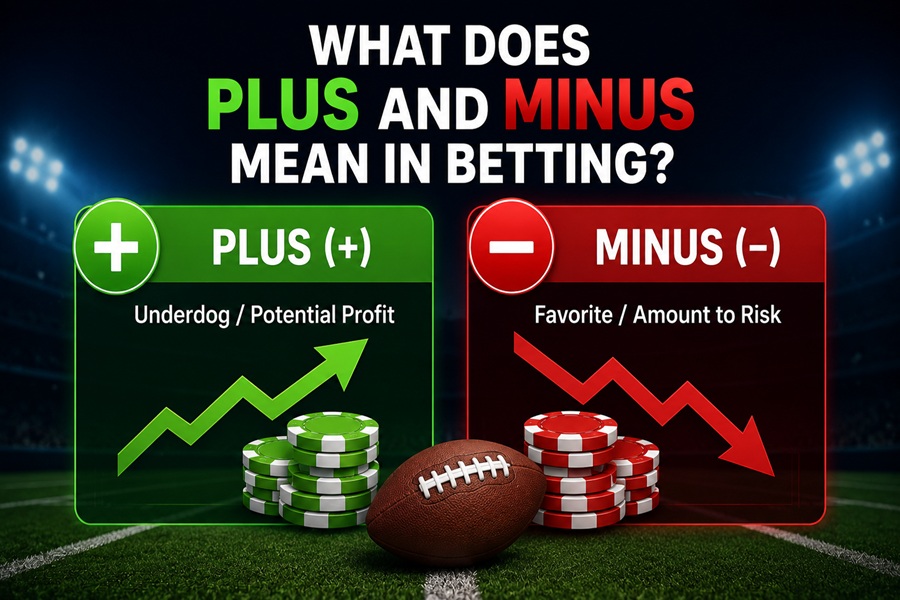
Quick answer: In betting, the minus sign (-) marks the favorite and the plus sign (+) marks the underdog. On the odds themselves, minus tells you how much you must bet to win $100, and plus tells you how much profit you win on a $100 bet. So -150 means risk $150 to win $100, and +150 means a $100 bet wins $150 profit. On a point spread, minus shows how many points the favorite must win by, and plus shows how many points the underdog can lose by and still cover.
Open any US sportsbook and you are met with a wall of numbers wearing plus and minus signs. It looks like code. It is not. Once you learn the two jobs those signs do, every line on the screen becomes readable.
This guide decodes plus and minus completely, with worked examples, quick-reference tables, and the one advanced idea most beginners miss: the hidden fee baked into every number.
What do plus and minus mean in betting odds?
These signs are the heart of the American odds system. Start with the simple version.
- Minus (-) is the favorite. The team or outcome more likely to win. The number tells you how much you must stake to win $100.
- Plus (+) is the underdog. The team or outcome less likely to win. The number tells you how much profit you win on a $100 stake.
Two quick examples on a moneyline, which is a straight bet on who wins:
- A team at -150 is the favorite. You risk $150 to win $100 in profit.
- A team at +150 is the underdog. You risk $100 to win $150 in profit.
The bigger the minus number, the heavier the favorite and the smaller the payout. The bigger the plus number, the longer the underdog and the larger the payout.
How do you calculate payouts from plus and minus odds?
You do not need a calculator app, because the sportsbook shows your potential return. But knowing the math helps you spot value fast.
For minus (favorite) odds: Profit = stake x (100 / the number). So a $60 bet at -150 returns 60 x (100 / 150) = $40 profit.
For plus (underdog) odds: Profit = stake x (the number / 100). So a $60 bet at +150 returns 60 x (150 / 100) = $90 profit.
Here is a reference table for a $100 stake so you can see the pattern.
| Odds | Type | Bet | Profit if it wins | Total return |
|---|---|---|---|---|
| -200 | Favorite | $100 | $50 | $150 |
| -150 | Favorite | $100 | $66.67 | $166.67 |
| -110 | Slight favorite | $100 | $90.91 | $190.91 |
| +100 | Even money | $100 | $100 | $200 |
| +150 | Underdog | $100 | $150 | $250 |
| +300 | Big underdog | $100 | $300 | $400 |
Notice +100. That is “even money,” where a winning $100 bet returns $100 profit. Some books write it as EVEN or -100.
Do plus and minus mean something different on a point spread?
Yes, and this is where beginners get tangled. The same signs do a second, different job on a point spread.
A point spread is a handicap that levels an uneven matchup. Here the sign is attached to a number of points, not to a payout.
- Minus on the spread means the favorite must win by more than that number. A team at -7 must win by 8 or more for the bet to cash.
- Plus on the spread means the underdog gets a head start. A team at +7 can lose by 6, or win outright, and the bet still cashes.
So a team at +7 “covers” if it loses by fewer than 7, ties the margin, or wins. A team at -7 covers only if it wins by 8 or more.
Two terms that go with spreads:
- Push. If the favorite wins by exactly the spread number, say a -7 team winning by 7, the bet is a push and your stake is returned.
- The hook. That is the half point, like -7.5 or +7.5. Books add it to remove the push, so every bet has a clear winner or loser.
The trap to avoid: a spread line usually has two numbers, like +3.5 (-110). The +3.5 is the points. The -110 is the price you pay. Always read the market label and separate the handicap from the odds.
What about plus and minus on totals and props?
The pattern holds. On a total, also called the over/under, the sportsbook sets a combined score, and each side has a price.
- The total might be 45.5.
- Both the over and the under are commonly priced around -110.
That -110 is not a spread. It is the odds, telling you to risk $110 to win $100. The same is true for player props and most other markets. Whenever you see a price like -110 or -115 next to a bet, that is the payout side of the plus-minus system, not a handicap.
Why are two even teams both listed at -110?
This is the single most useful thing to understand, and most quick explainers skip it.
If two outcomes were truly a coin flip, fair odds would be +100 on each side. Instead you usually see -110 on both. That extra cost is the sportsbook’s built-in fee, called the vig or juice.
Here is how it works. At -110, you risk $110 to win $100. Bet both sides and you stake $220 but only get $210 back on the winner, so the book keeps $10 no matter who wins, as long as betting is balanced.
You can see the fee another way, through implied probability.
How do you convert plus and minus odds into a probability?
Every line carries an implied probability, which is the chance of winning that the odds suggest.
For minus (favorite) odds: Implied probability = the number / (the number + 100). So -150 implies 150 / 250 = 60 percent.
For plus (underdog) odds: Implied probability = 100 / (the number + 100). So +150 implies 100 / 250 = 40 percent.
Now the vig becomes visible. Take a -110 versus -110 market:
- -110 implies about 52.4 percent.
- The other -110 also implies about 52.4 percent.
- Added together, that is about 104.8 percent.
A fair market would total 100 percent. That extra 4.8 percent is the overround, the sportsbook’s margin baked into the prices. It is why beating sports betting long term is hard: you are not just predicting winners, you are overcoming that built-in tax on every bet.
How often do you need to win to break even?
Because of the vig, minus odds require you to win more than half the time just to stay even. This table shows the break-even win rate for common prices.
| Odds | Implied probability (break-even win rate) |
|---|---|
| -200 | 66.7% |
| -150 | 60% |
| -110 | 52.4% |
| +100 | 50% |
| +150 | 40% |
| +200 | 33.3% |
The takeaway: a -150 favorite is not a “safe” bet just because it is likely to win. You still need to hit it 60 percent of the time across many bets to come out ahead. A minus favorite feels safer and quietly demands a higher win rate.
Why do the same odds differ between sportsbooks?
Prices are not fixed. They move with betting action and news, and they vary from book to book.
One book might price an over at -112 while another has the same over at -119. That gap is real money over time. Betting the cheaper price, a habit called line shopping, lowers the vig you pay and is one of the few edges available to a normal bettor. Having accounts at more than one book lets you always take the better number.
For context, American plus-minus odds are one of three formats. Fractional odds (like 5/1) are common in the UK, and decimal odds (like 6.00) are standard in Europe. They all express the same thing in different clothing.
Frequently asked questions about plus and minus in betting
What does minus mean in betting?
The minus sign marks the favorite. On the odds, it is how much you must bet to win $100, so -150 means risk $150 to win $100. On a spread, it is the points the favorite must win by.
What does plus mean in betting?
The plus sign marks the underdog. On the odds, it is the profit on a $100 bet, so +150 wins $150. On a spread, it is the head start the underdog receives.
What does -110 mean?
It means you risk $110 to win $100. It is the standard price on most spreads and totals, and the extra $10 is the sportsbook’s vig.
Is plus or minus better to bet?
Neither is automatically better. Minus favorites win more often but pay less and demand a higher win rate to profit. Plus underdogs win less often but pay more. Value depends on the true probability versus the implied odds.
What happens if a spread lands exactly on the number?
That is a push. Your original stake is returned. Sportsbooks add a half point, the hook, to many lines specifically to avoid pushes.
How do I turn odds into a percentage chance?
For minus odds, divide the number by the number plus 100. For plus odds, divide 100 by the number plus 100. That gives the implied probability the line is offering.